


Aiding Legal Services

Aiding Legal Services

By Rolivhuwa Munyai

Meet Thato Khosa, a Paralegal Intern in the Legal Services Department at GEP, he began his internship on the 1st of August 2024, bringing with him a Diploma in Legal Assistance. Prior to joining GEP, Thato gained valuable experience as a legal assistant at the Pretoria Magistrate Court and as a policy administrator at Moto Vantage (Pty) Ltd. In these roles, he developed skills in legal research, case file management and administrative support.

Since joining GEP, Thato has expanded his knowledge of corporate legal processes, contract management and regulatory compliance. He has also refined his problem-solving and critical thinking skills. Thato’s motivation for applying for the internship was to gain hands-on experience in corporate and business law, enhance his legal knowledge, and contribute meaningfully to GEP’s mission of supporting entrepreneurs and businesses.

As a Paralegal Intern, Thato’s responsibilities include assisting with contract drafting and review, conducting legal research, preparing reports, managing case files and documentation, providing administrative support to the legal team, and ensuring compliance with legal regulations and company policies.

At the beginning of the internship, Thato struggled to adapt to the fast-paced legal environment, however, he overcame this by seeking mentorship, asking for clarity when needed and continuously improving time management skills.

Thato has received valuable support and guidance from his supervisor and colleagues and appreciates the organization’s commitment to professional development and its impact on the business community.

When asked about recommendations for improving the internship program, he suggested implementing structured mentorship sessions, providing regular feedback and career guidance, and offering exposure to cross-departmental projects to enhance the overall learning experience.

Reflecting on his experience with the GEP, Thato described it as rewarding and enriching. He appreciated the culture of collaboration, learning and professional growth, which has positively shaped his career aspirations. Thato felt welcomed and valued as a member of the team, and his contributions were acknowledged. He was given responsibilities that allowed him to develop and showcase his skills.

GEP hosts successful induction and wellness session

GEP hosts successful induction and wellness session

By Rolivhuwa Munyai

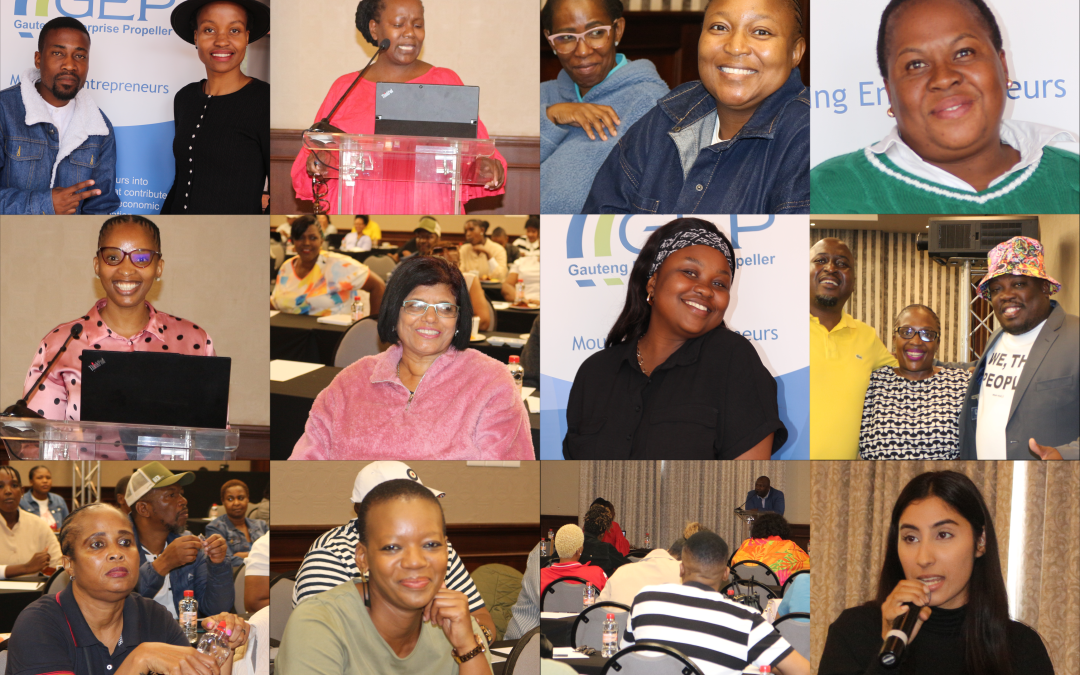
On 27 March 2025, the Gauteng Enterprise Propeller (GEP)’s HR unit hosted an induction and wellness event for all employees at the Gold Reef City Theme Park hotel, in Johannesburg. The event aimed to foster team building, introduce employees to different unit managers, and to offer holistic wellness programs to promote employee well-being.

The event was led by Ms. Thenjiwe, who welcomed attendees from the GEP’s 5 regions, steering the day’s discussions and presentations as Program Director.

Mr. Sello Manoto, Acting General Manager: CSA, emphasized the unit’s vital role in verifying work across regions, departments and units including Finance. He highlighted the importance of oversight in maintaining trustworthy reporting to shareholders.

Mr Manoto commended the team for their excellent work, stating, “I am pleased to report that we have achieved all our targets for the current financial year”.

Mr. Imraan Khan, Chief Operations Officer, presented an overview of his unit consisting of five (5) Regional Managers and sub-divisions. He further gave context into the GEP’s Financial support programs, including start-up, expansion and franchise finance and non-financial support programs such as business development and advisory services.

Ms. Yanga Mahlawe, Risk and Audit Manager, provided an overview of her unit’s key functions and initiatives, including Risk Management, Compliance, Internal Audit and Fraud Management. She highlighted the unit’s fraud hotline with multiple reporting channels, including WhatsApp, e-mail and online chat. Ms. Mahlawe further announced plans to conduct workshops in the new financial year to educate staff on policies, compliance and tools to ensure compliance and achieve positive audit outcomes.

The GEP demonstrated its commitment to employee success, well-being and growth by inviting a wellness company, My Company Wellness Solutions, to present their holistic wellness programs including unlimited face-to-face counselling, mental health enhancement and support, legal advice, fitness and nutrition support, among others. By availing these offerings, the GEP aims to increase job satisfaction, productivity and retention among employees.

The induction and wellness event was a resounding success, providing employees with valuable insights into the GEP’s  various units and services. The event reinforced the GEP’s commitment to employee well-being and success, setting a positive tone for the year ahead.

By Rolivhuwa Munyai

Link to photos

Inspiring Young Minds

Inspiring Young Minds

By Rolivhuwa Munyai

Meet Nomalanga Tshatsha, the Youth Placement Program Manager who manages the internship program designed to support the Province’s commitment to empowering young people. The primary objective of this program is to provide unemployed youth in Gauteng with on-the-job skills development and training opportunities at different host companies.

The Youth Placement Program offers a twelve (12) month placement opportunity for unemployed youth with an annual intake of 100 young people as per the Gauteng Enterprise Propeller’s APP target.

The recruitment process commences once the unit receives its budget allocation, with a particular focus on graduates in fields of study required by the host company.

Selected interns undergo induction which takes place on the day of contract signing. As a Program Manager, Nomalanga prides herself with seeing Gauteng youth acquire on-the-job skills, making them more attractive to future employers.

Nomalanga Tshatsha has further highlighted plans to expand the program by increasing participant intake and duration subject to a budget allocation increase. The program is aligned to Gauteng’s developmental agenda, seeing the youth learn new skills that match their qualifications and gain work experience that will propel their future careers.

Q4 2025 – Gross Domestic Product

Q4 2025 – Gross Domestic Product

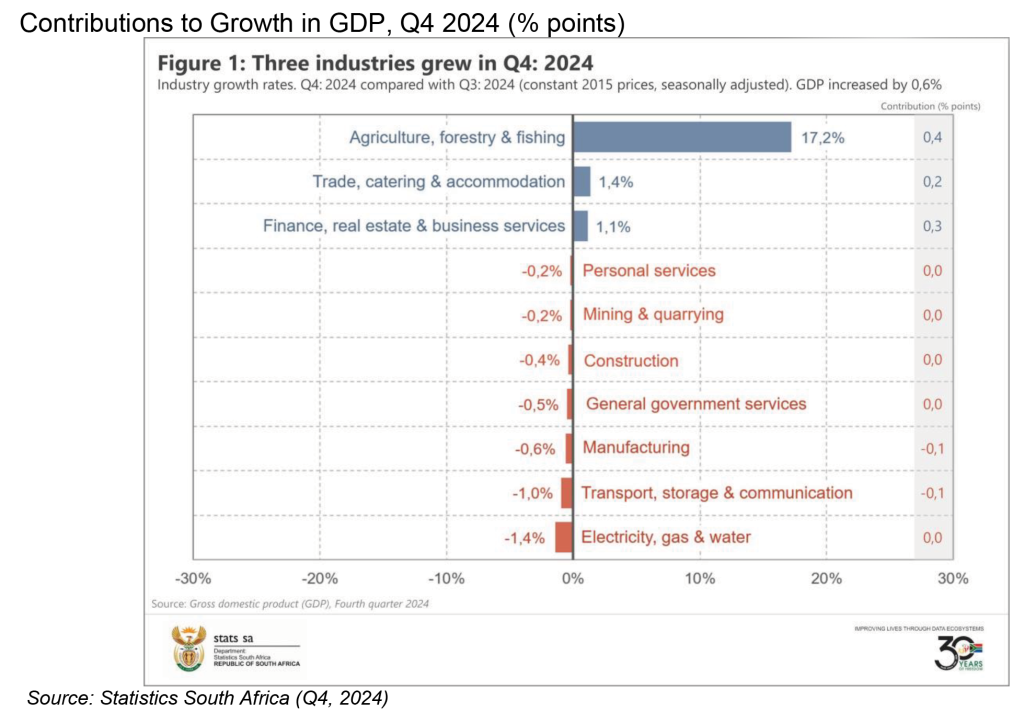
South Africa’s gross domestic product (GDP) GDP increased by 0,6% in the fourth quarter of 2024. Growth was led by agriculture, finance and trade on the supply (production) side of the economy.

Gross Domestic Product (measured by production)
Three industries recorded positive growth in the fourth quarter of 2024:
Agriculture had the most significant positive impact on GDP growth on the supply side of the economy. Following a sharp decline in the third quarter, the industry rebounded by 17,2%, lifting GDP growth by 0,4 of a percentage point. This was mainly due to a rise in the production of field crops and animal products.

The finance, real estate & businesses services industry grew for an eighth consecutive quarter, with financial intermediation, real estate activities and other business services the largest positive contributors to growth. The industry increased by 1,1%, contributing 0,3 of a percentage point.

The trade, catering and accommodation industry expanded on the back of increased retail, wholesale and motor trade sales. This reflected positively on the demand side of the economy, with household consumption spending rising in the fourth quarter. The industry increased by 1,4%, contributing 0,2 of a percentage point.

Seven industries recorded negative growth:
Seven industries performed poorly, with manufacturing and transport, storage & communication the most significant negative contributors to growth.

Manufacturing was mainly pulled lower by weaker production levels in the metals & machinery and automotive divisions. The industry decreased by 0,6%, contributing -0,1 of a percentage point. Six of the ten manufacturing divisions reported negative growth rates. The largest negative contributions were reported for the basic iron and steel, non-ferrous metal products, metal products and machinery division and the motor vehicles, parts and accessories and other transport equipment division.

Transport, storage & communication recorded a fourth consecutive quarter of decline. The industry witnessed a pullback in land transport and transport support services. The industry decreased by 1,0%, contributing -0,1 of a percentage point.

Mining activity was down on weaker production levels for manganese ore, iron ore, gold, chromium ore, nickel and copper. Coal and platinum group metals were positive, but not enough to keep the industry above water. The industry decreased by 0,2%.

The construction industry decreased by 0,4%. Decreases were reported for residential and non-residential buildings.

The electricity, gas and water industry decreased by 1,4%. This was largely due to decreases in electricity production and consumption.

General government services decreased by 0,5%. This was mainly due to decreased employment in national and provincial government and extra-budgetary institutions.

The personal services industry decreased by 0,2%. Decreased economic activities were reported for health and education.

Q4 2024 – Employment Statistic

Q4 2024 – Employment Statistic

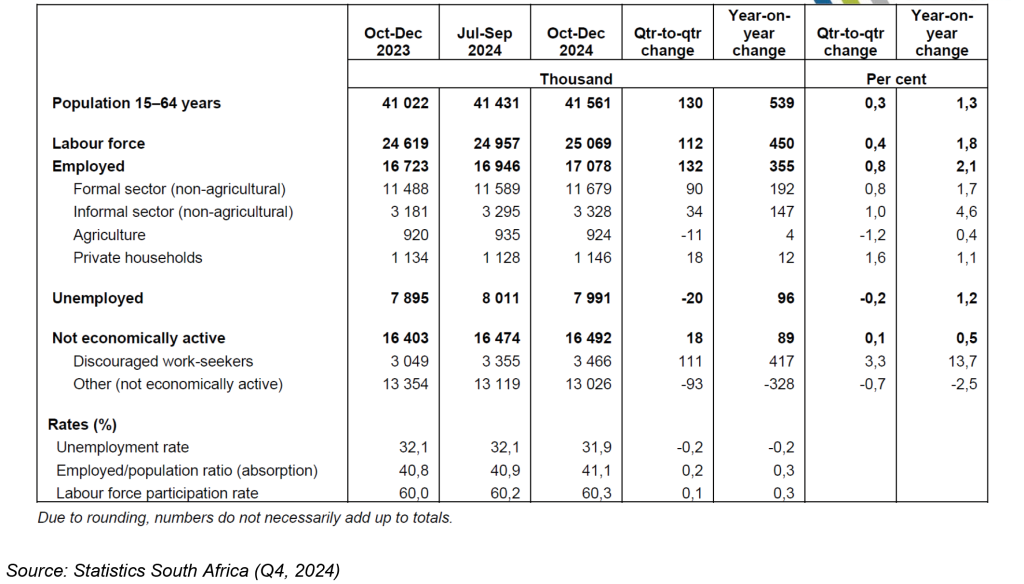
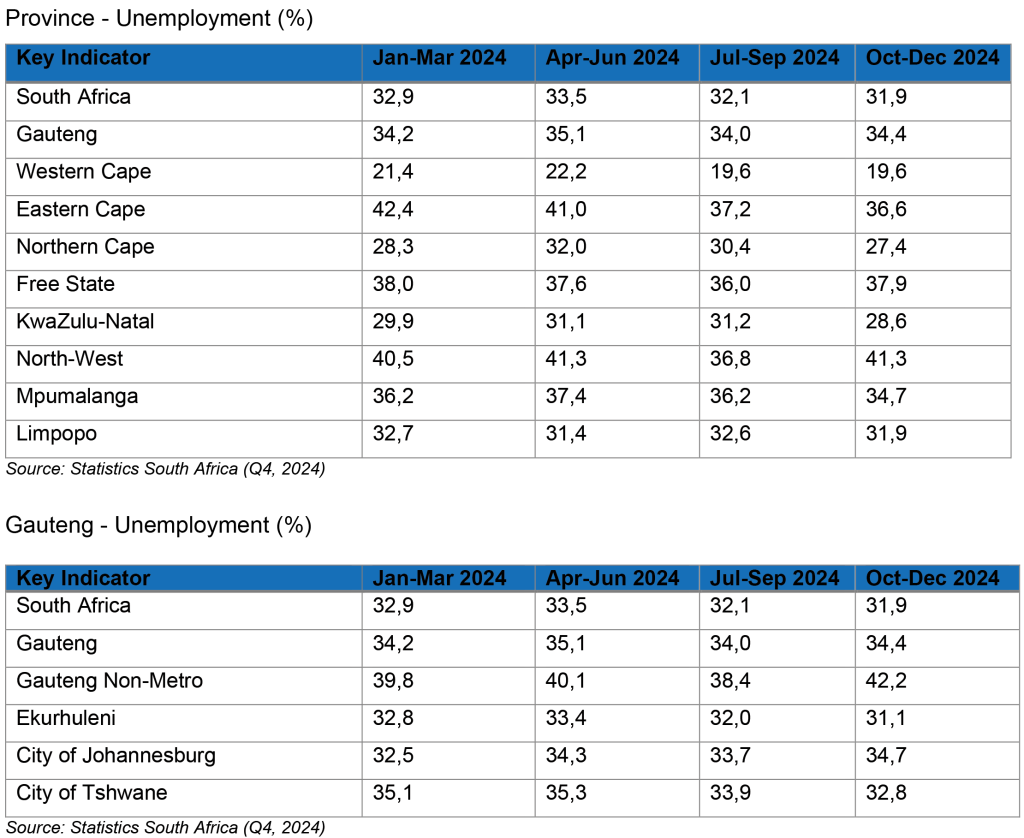
The Statistics South Africa results of the Quarterly Labour Force Survey (QLFS) released on 18 February indicate the official unemployment rate was 31,9% in the fourth quarter of 2024.

According to the QLFS Q4: 2024 results, there was an increase of 132 000 in the number of employed persons to 17,1 million in Q4: 2024, while there was a decrease of 20 000 in the number of unemployed persons to 8,0 million. This resulted in an increase of 112 000 (up by 0,4%) in the labour force during the same period. Discouraged work-seekers increased by 111 000 (up by 3,3%), and the number of persons who were not economically active for reasons other than discouragement decreased by 93 000 (down by 0,7%) between the third quarter and fourth quarter of 2024. This led to an increase of 18 000 in the number of the not economically active population to 16,5 million.

The above changes in employment and unemployment resulted in the official unemployment rate decreasing by 0,2 of a percentage point from 32,1% in the third quarter of 2024 to 31,9% in the fourth quarter of 2024. The expanded unemployment rate in the fourth quarter of 2024 remained unchanged at 41,9% when compared with the third quarter of 2024.

Employment by Industry

Between Q3: 2024 and Q4: 2024, the number of employed persons increased in four of the ten industries. The increases in employment were recorded in Finance (232 000), followed by Manufacturing (41 000), Private Households (18 000) and Transport (17 000) industries. The largest decreases in employment were recorded in Community and Social Services (63 000), followed by Trade (48 000) and Construction (22 000) industries.

Compared with the same period last year, a net increase of 355 000 in total employment in Q4: 2024 was largely due to increases in the number of people employed in Manufacturing (168 000), Trade (59 000), Community and Social Services (46 000) and Transport (41 000) industries. The industries that recorded decreases were Finance (16 000) and Utilities (12 000).

Formal Sector
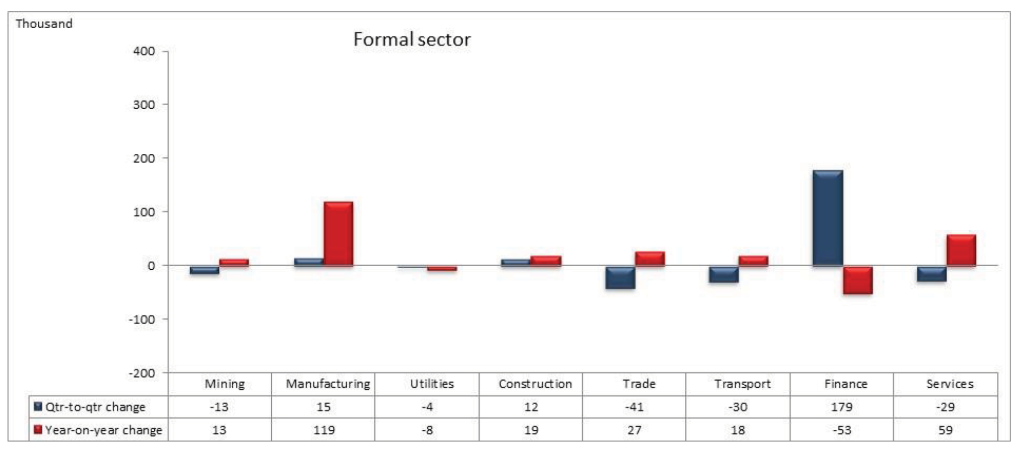
Employment in the formal sector increased by 90 000 in Q4: 2024 compared with Q3: 2024.

The fourth quarter of 2024 recorded formal sector employment increases in Finance (179 000), Manufacturing (15 000) and Construction (12 000) industries compared with the third quarter of 2024. During the same period, decreases in the formal sector employment were recorded in Trade (41 000), Transport (30 000), Community and Social Services (29 000), Mining (13 000) and Utilities (4 000).

Compared with a year ago, a net gain of 192 000 jobs in the formal sector employment was mainly driven by Manufacturing (119 000), Community and Social Services (59 000) and Trade (27 000) industries in Q4: 2024. Employment losses were observed in Finance (53 000) and Utilities (8 000) industries during the same period.

Formal Sector by Industry

Informal Sector

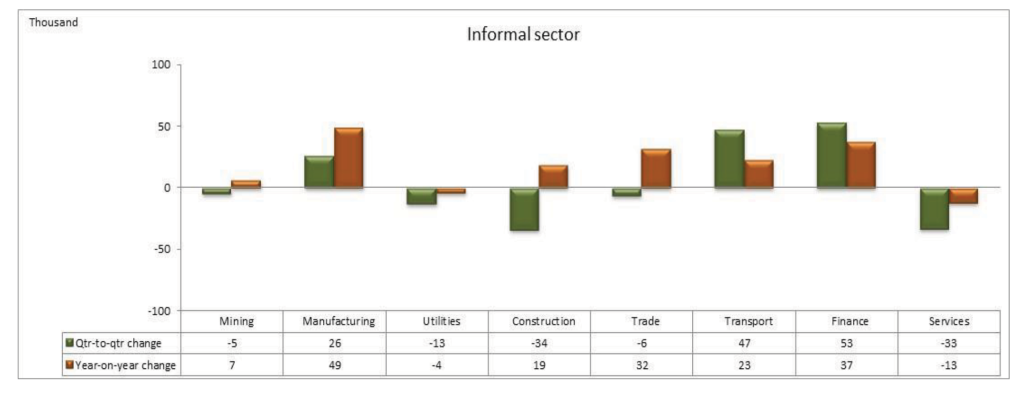
Following an increase of 165 000 in Q3: 2024, informal sector employment increased by 34 000 in Q4: 2024.

In the fourth quarter of 2024, informal sector employment increased by 34 000 persons compared with the previous quarter. Gains in the informal sector employment were driven by Finance (53 000), Transport (47 000) and Manufacturing (26 000) industries.

Compared with Q4: 2023, the employment increase in the informal sector was mainly driven by Manufacturing (49 000), Finance (37 000) and Trade (32 000) industries. Losses in employment were recorded in the Community and Social Services (13 000) and Utilities (4 000) industries during the same period.

Informal Sector by Industry

Employment by Province

The number of employed persons increased in six provinces between Q3: 2024 and Q4: 2024. Employment gains were recorded in Western Cape (62 000), KwaZulu-Natal (52 000), Gauteng (45 000), Northern Cape (18 000), Mpumalanga (13 000) and Eastern Cape (4 000). Employment decreases were recorded in Free State (25 000), North-West (20 000) and Limpopo (16 000) during the same period.

Compared with Q4: 2023, the largest increases in employment were recorded in Eastern Cape (108 000), Western Cape (55 000), Gauteng (47 000) and Limpopo (45 000). Mpumalanga recorded the lowest increase in employment with 4 000 during the same period. Northern Cape had the largest year-on-year percentage change increase in employment of 8,5%.