


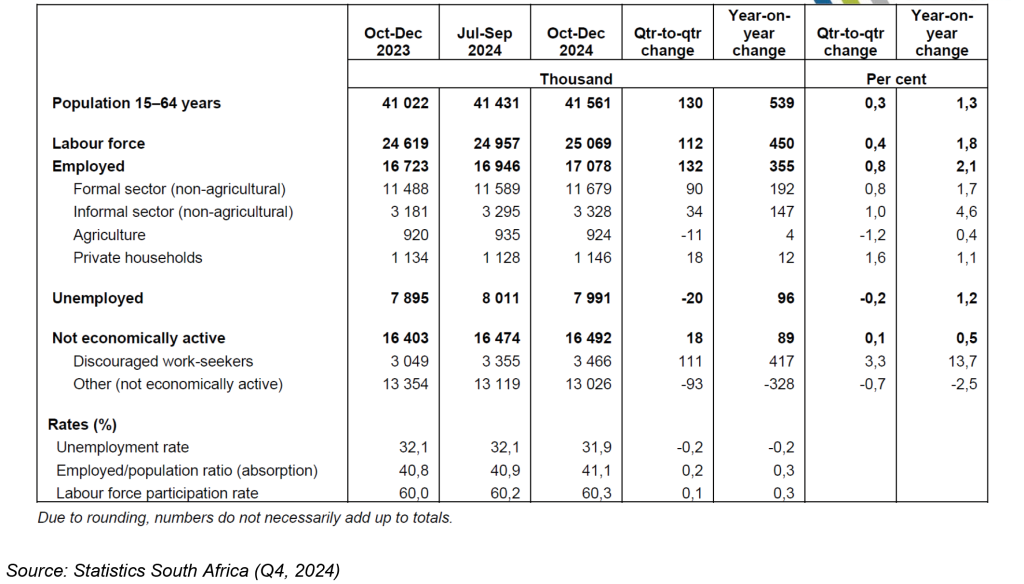
The Statistics South Africa results of the Quarterly Labour Force Survey (QLFS) released on 18 February indicate the official unemployment rate was 31,9% in the fourth quarter of 2024.
According to the QLFS Q4: 2024 results, there was an increase of 132 000 in the number of employed persons to 17,1 million in Q4: 2024, while there was a decrease of 20 000 in the number of unemployed persons to 8,0 million. This resulted in an increase of 112 000 (up by 0,4%) in the labour force during the same period. Discouraged work-seekers increased by 111 000 (up by 3,3%), and the number of persons who were not economically active for reasons other than discouragement decreased by 93 000 (down by 0,7%) between the third quarter and fourth quarter of 2024. This led to an increase of 18 000 in the number of the not economically active population to 16,5 million.
The above changes in employment and unemployment resulted in the official unemployment rate decreasing by 0,2 of a percentage point from 32,1% in the third quarter of 2024 to 31,9% in the fourth quarter of 2024. The expanded unemployment rate in the fourth quarter of 2024 remained unchanged at 41,9% when compared with the third quarter of 2024.
Employment by Industry
Between Q3: 2024 and Q4: 2024, the number of employed persons increased in four of the ten industries. The increases in employment were recorded in Finance (232 000), followed by Manufacturing (41 000), Private Households (18 000) and Transport (17 000) industries. The largest decreases in employment were recorded in Community and Social Services (63 000), followed by Trade (48 000) and Construction (22 000) industries.
Compared with the same period last year, a net increase of 355 000 in total employment in Q4: 2024 was largely due to increases in the number of people employed in Manufacturing (168 000), Trade (59 000), Community and Social Services (46 000) and Transport (41 000) industries. The industries that recorded decreases were Finance (16 000) and Utilities (12 000).
Formal Sector
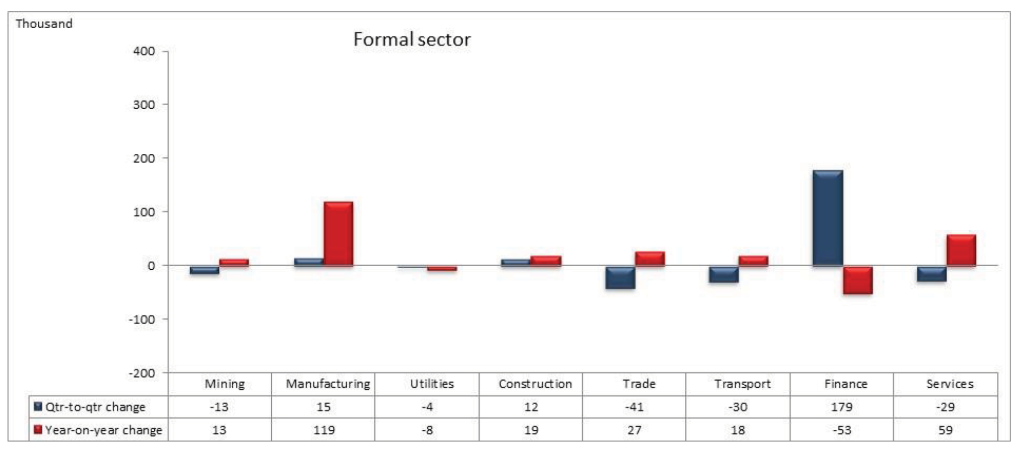
Employment in the formal sector increased by 90 000 in Q4: 2024 compared with Q3: 2024.
The fourth quarter of 2024 recorded formal sector employment increases in Finance (179 000), Manufacturing (15 000) and Construction (12 000) industries compared with the third quarter of 2024. During the same period, decreases in the formal sector employment were recorded in Trade (41 000), Transport (30 000), Community and Social Services (29 000), Mining (13 000) and Utilities (4 000).
Compared with a year ago, a net gain of 192 000 jobs in the formal sector employment was mainly driven by Manufacturing (119 000), Community and Social Services (59 000) and Trade (27 000) industries in Q4: 2024. Employment losses were observed in Finance (53 000) and Utilities (8 000) industries during the same period.
Formal Sector by Industry
Informal Sector
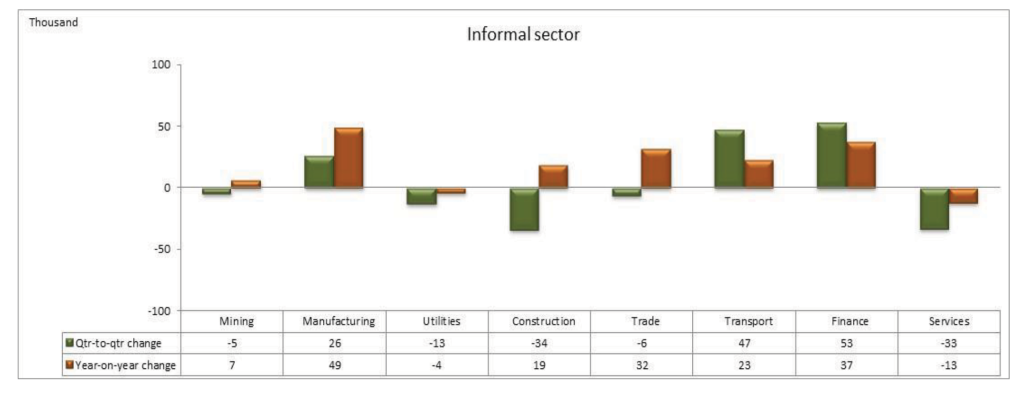
Following an increase of 165 000 in Q3: 2024, informal sector employment increased by 34 000 in Q4: 2024.
In the fourth quarter of 2024, informal sector employment increased by 34 000 persons compared with the previous quarter. Gains in the informal sector employment were driven by Finance (53 000), Transport (47 000) and Manufacturing (26 000) industries.
Compared with Q4: 2023, the employment increase in the informal sector was mainly driven by Manufacturing (49 000), Finance (37 000) and Trade (32 000) industries. Losses in employment were recorded in the Community and Social Services (13 000) and Utilities (4 000) industries during the same period.
Informal Sector by Industry
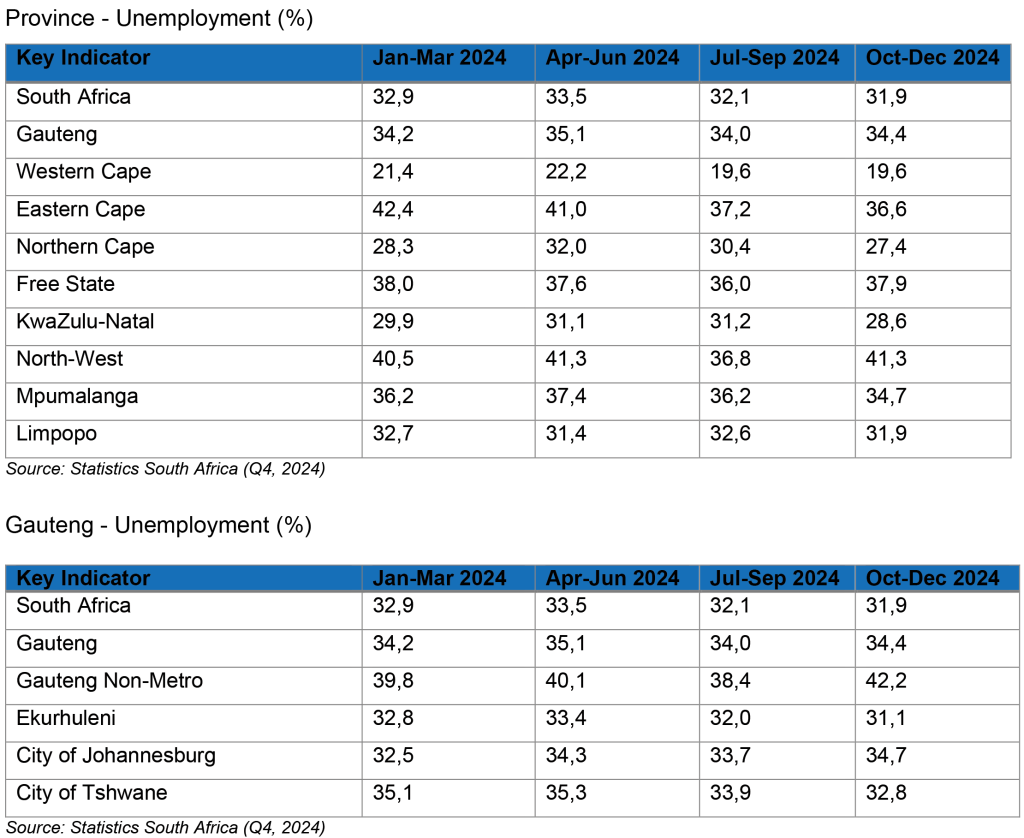
Employment by Province
The number of employed persons increased in six provinces between Q3: 2024 and Q4: 2024. Employment gains were recorded in Western Cape (62 000), KwaZulu-Natal (52 000), Gauteng (45 000), Northern Cape (18 000), Mpumalanga (13 000) and Eastern Cape (4 000). Employment decreases were recorded in Free State (25 000), North-West (20 000) and Limpopo (16 000) during the same period.
Compared with Q4: 2023, the largest increases in employment were recorded in Eastern Cape (108 000), Western Cape (55 000), Gauteng (47 000) and Limpopo (45 000). Mpumalanga recorded the lowest increase in employment with 4 000 during the same period. Northern Cape had the largest year-on-year percentage change increase in employment of 8,5%.